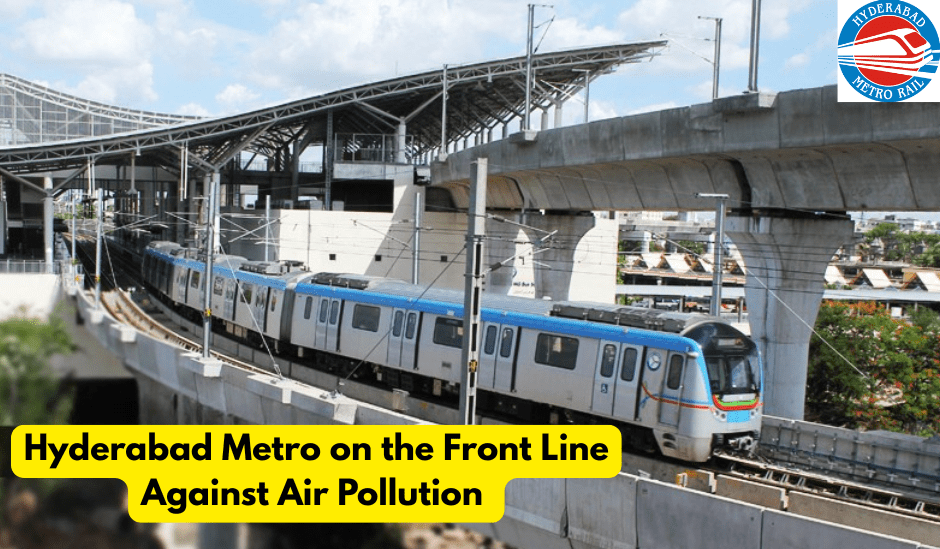
Hyderabad is growing fast. New offices rise, neighbourhoods expand, and daily commutes stretch longer each year. With that growth comes a familiar urban challenge: pollution. More vehicles on the road mean higher emissions, poorer air quality, and mounting pressure on public health.
Against this backdrop, the Hyderabad Metro is emerging as one of the city’s most powerful tools to fight urban pollution. Its continued expansion is not just a transport milestone. It is an environmental strategy in motion.
A growing network with environmental impact
Hyderabad today hosts the fifth largest metro rail network in India, a scale that places it among the country’s most ambitious urban transit systems. This growth has been highlighted in a national infrastructure study examining how metro rail networks contribute to cleaner cities.
The central idea is simple but powerful. Every commuter who chooses metro over a private vehicle represents fewer tailpipe emissions, less congestion, and lower fuel consumption. When scaled across lakhs of daily riders, the environmental gains compound quickly.
Metro systems shift travel behaviour. Instead of fragmented car and two-wheeler trips, commuters move in high-capacity electric trains designed for efficiency. This transition directly reduces the pollution burden created by road transport, historically one of the largest contributors to urban air degradation.
Evidence that metros clean the air
Research reviewed in the infrastructure study reinforces what many planners have long argued: metro rail is not just mobility infrastructure; it is environmental infrastructure.
A landmark analysis of Delhi’s metro system during its early operational years recorded a 34 percent drop in carbon monoxide levels at a major traffic intersection. This decline pointed directly to fewer road emissions as metro ridership increased.
Global findings echo similar patterns. Urban areas account for roughly 70 percent of worldwide carbon dioxide emissions. Experts increasingly view low-carbon mass transit systems as one of the most effective levers available to rapidly urbanising cities.
Studies show that introducing subway systems can reduce particulate pollution in surrounding urban cores by about 4 percent. In cities that begin with high pollution baselines, the relative gains can be even more meaningful.
World Bank research examining nearly two hundred metro-enabled cities found that such systems significantly cut transport-related emissions. The takeaway is clear: when cities invest in electric mass transit, air quality improves.
Why this matters for Hyderabad
Hyderabad’s economic expansion is accelerating. Tech corridors are growing, residential clusters are spreading outward, and daily commuting patterns are intensifying. Without intervention, this growth would inevitably push vehicle emissions higher.
The metro offers a scalable alternative. Electric rail transport dramatically reduces per-passenger emissions compared to private vehicles. As the network expands and ridership deepens, the cumulative environmental benefit grows alongside it.
Cleaner air is not an abstract metric. It translates into better respiratory health, reduced urban heat stress, and a more liveable city environment. Fewer vehicles also mean quieter streets and improved public spaces.
Importantly, metro-led mobility encourages transit-oriented development. Dense, walkable urban clusters around stations reduce dependence on long vehicle trips, reinforcing a cycle of sustainable growth.
Beyond transport, a climate strategy
Hyderabad Metro represents more than infrastructure expansion. It is a forward-looking climate intervention embedded within the city’s growth model.
By reducing dependence on fossil-fuel vehicles, the system directly contributes to emission control. At the same time, it demonstrates how modern cities can align mobility planning with environmental responsibility.
As Hyderabad continues to grow, the metro’s role will only become more central. Each extension is not just new track on a map. It is a measurable step toward cleaner air, lower emissions, and a healthier urban future.
In the larger fight against pollution, Hyderabad’s metro is proving that the tracks to progress can also be the tracks to sustainability.