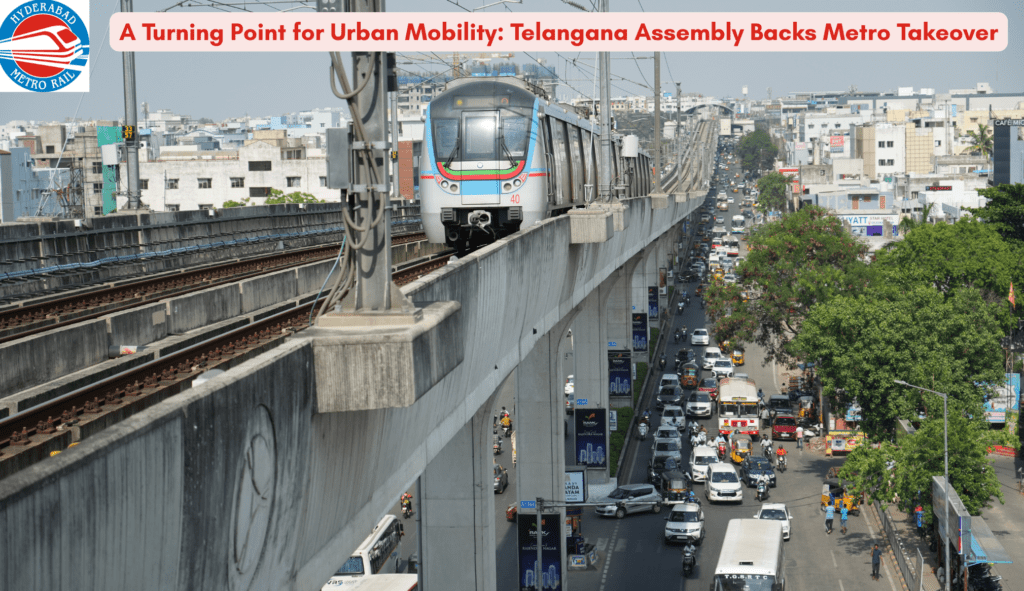
In a decisive move that could reshape the future of urban transport in Hyderabad, the Telangana Legislative Assembly has backed the state government’s proposal to take over Phase-I of the Hyderabad Metro Rail Project. The resolution, passed on March 28th 2026, signals not just a policy shift but a strategic reset for one of India’s most ambitious metro systems.
At the heart of this decision is the vision articulated by Chief Minister A. Revanth Reddy to bring the metro network under stronger public control and accelerate its expansion in line with the city’s rapid growth. The resolution authorizes the takeover of the 69-km Phase-I network from Larsen & Toubro, which has operated the project under a public-private partnership (PPP) model since 2010.
Why This Move Matters Now
Hyderabad’s skyline has transformed dramatically over the past decade but its metro expansion has not kept pace. As highlighted by Legislative Affairs Minister D. Sridhar Babu, the city has slipped from being among the top metro networks in India to ninth position in terms of network length.
This gap between urban growth and transport infrastructure has triggered increasing demand for expansion, especially across core urban and emerging corridors. The government’s response is ambitious: a combined 162.5 km expansion plan under Phase-IIA and Phase-IIB.
- Phase-IIA: 76.4 km across five key corridors, including connectivity to the airport and growing suburban zones
- Phase-IIB: 86.1 km across three additional corridors, extending reach into future growth hubs
Together, these phases represent not just expansion, but a recalibration of Hyderabad’s long-term mobility strategy.
From PPP to Public Control: A Strategic Shift
The Hyderabad Metro’s Phase-I was awarded to L&T under a 35-year PPP model, with operations beginning between 2017 and 2020. While the model enabled rapid execution, it also posed challenges for integrated expansion, especially when new corridors needed alignment with an existing privately operated network.
The Union government, through the Ministry of Housing and Urban Affairs, emphasized seamless operational integration for future phases. However, L&T declined to participate as an equity partner in Phase-II, citing corporate policy, and instead offered an exit, provided the state assumes its debt and compensates equity.
The Telangana government accepted this pathway.
With cabinet approval granted on February 23, 2026, the state has now committed to acquiring Phase-I by taking on approximately ₹13,000 crore in debt and compensating equity, capping the total transaction at ₹15,000 crore through due legal process.
What Lies Ahead
The takeover is more than a financial transaction; it is a structural shift. By bringing Phase-I under public control, the state aims to unlock:
- Seamless network expansion across phases
- Unified operational planning and fare integration
- Faster decision-making aligned with urban growth patterns
With this move, Hyderabad could reclaim its position as a leader in metro connectivity while setting a precedent for how Indian cities rethink PPP-led infrastructure in evolving urban realities.
Conclusion: A Metro Moment for Hyderabad
This decision marks a defining moment in Hyderabad’s urban journey. It reflects a broader shift from building infrastructure to actively shaping how it evolves with the city.
With control, clarity, and a clear expansion roadmap, the Hyderabad Metro is no longer just a transport system; it is becoming the backbone of a future-ready, connected metropolis.